Fire, Breath, and Gold: Reawakening the Ritual of Jewelry
An interview with Colombian artist Ana María Jiménez on the ancient jewelers who inform her work, the magic of tumbaga, and the body as a tool
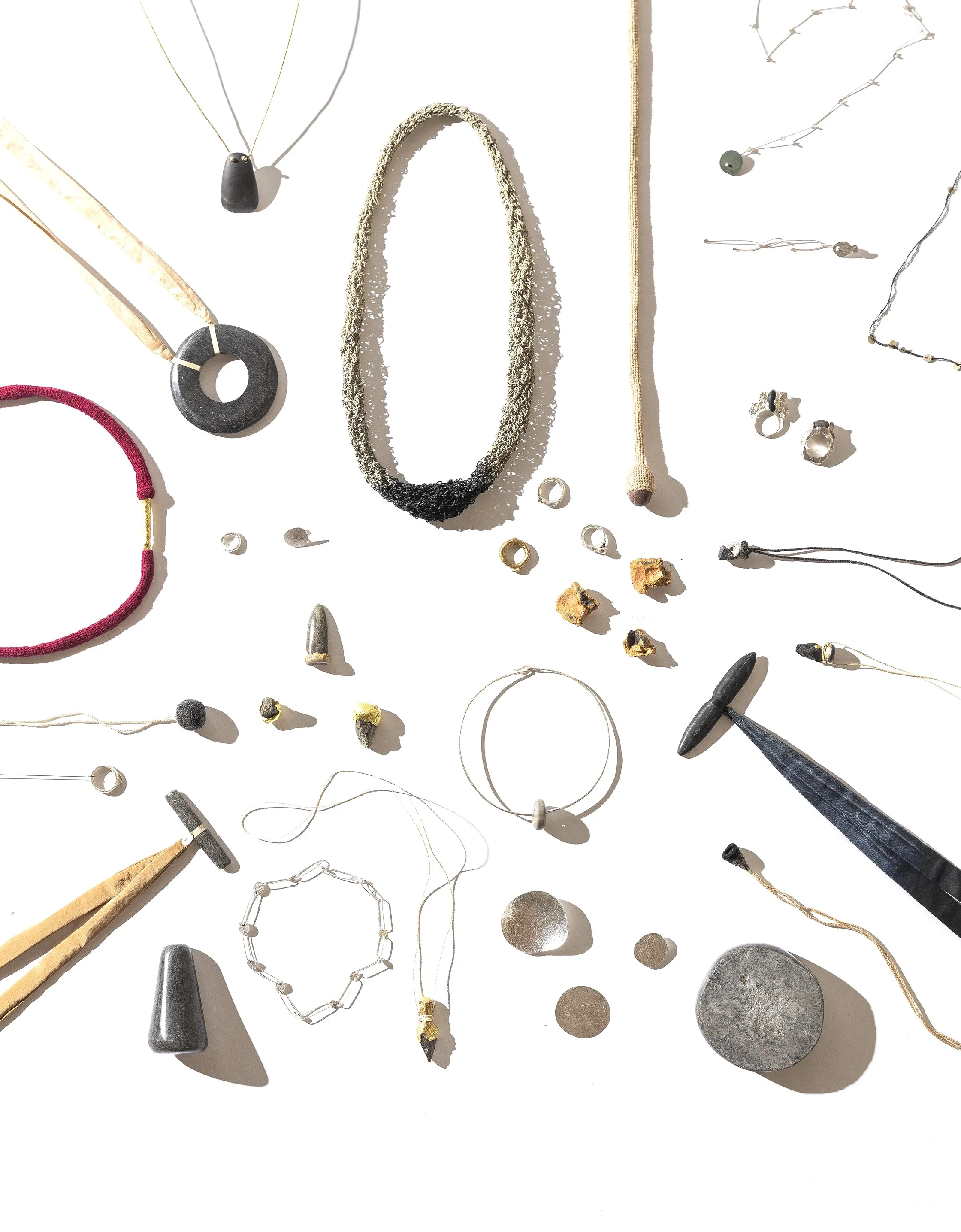
Work by Ana María Jiménez. Photo courtesy of Taller Sin Borde.
Marilena: I’m interested in your work because you research ancient goldsmithing practices and recreate them in your workshop. Your jewelry weaves together culture, tradition, and politics in a compelling way. Can you begin by describing your process?
Ana:
I think I am a very curious person. I love movement, and I’m drawn to things that make me feel something. That’s probably the first thing to say about me.
I don’t focus on only one discipline. I’m always working across different scales, shapes, and interests, and I like to move between them. I started with architecture, then moved into theater, jewelry, and, later, my master’s degree in the arts. For me, everything is connected. I’m deeply interested in creativity—how I can place my interests and what’s happening in my life into a creative space. Sometimes that creation becomes an object, sometimes jewelry, sometimes a space.
Right now, a new interest is emerging: meditation. It’s becoming a very important part of my life, and I see it as another path that’s still deeply connected to creativity.
What ties everything together is the creative process itself. I can feel how something develops inside me, and then I begin to create. My hands are my main way of doing things. That’s why making—working with my hands—is so important. Jewelry is something I love because of that, but it’s not everything for me.
Marilena: Two things stood out to me. First, your process feels very intuitive—something that begins before your hands even come into play. Could you talk about what you consciously do to support or facilitate that intuitive process?
Ana:
I’m a very sensitive person. I feel a lot, and that fills my interior world. The way I process and canalizar—channel—that is through my work. Creativity allows me to put everything somewhere.
I’m very conscious of what’s happening in my body and inside myself. That’s like my antenna– lo que me hace caminar. What guides me. Sometimes I need to stop and reconfigure, to see which currents are sustaining my work—what’s coming from outside and what’s coming from within.
Marilena: Are there specific things you feel especially attuned to? Relationships, world events, nature?
Ana:
I think I’m very sensitive to ways of living—formas de vivir—that disconnect us. Ways of living that unplug us from ourselves and from everything else. I need to be connected to my own route, my own way. I try to be so connected to myself that I know this is my life, not the life of others or the life society expects me to have.
I’m very sensitive to people. I’m conscious of presence—being present with others, with materials, with the environment. I’m drawn to forms of living that feel authentic. That’s actually where my research began. I felt like something was missing. I wasn’t even sure why I was making jewelry, because I don’t buy jewelry myself.
For example, during New York City Jewelry Week last November, I noticed how I didn’t really feel part of the jewelry world. What I’m interested in is different. I don’t like fashion or lujo, luxury. I was looking for something else.
Through my research, I’ve become very drawn to jewelry that feels more like ritual objects or amulets. How can a person put something into a piece of art that can’t be touched, something invisible—something like magic? That’s what interests me most: the rituals, the mysticism, the ways of doing things.
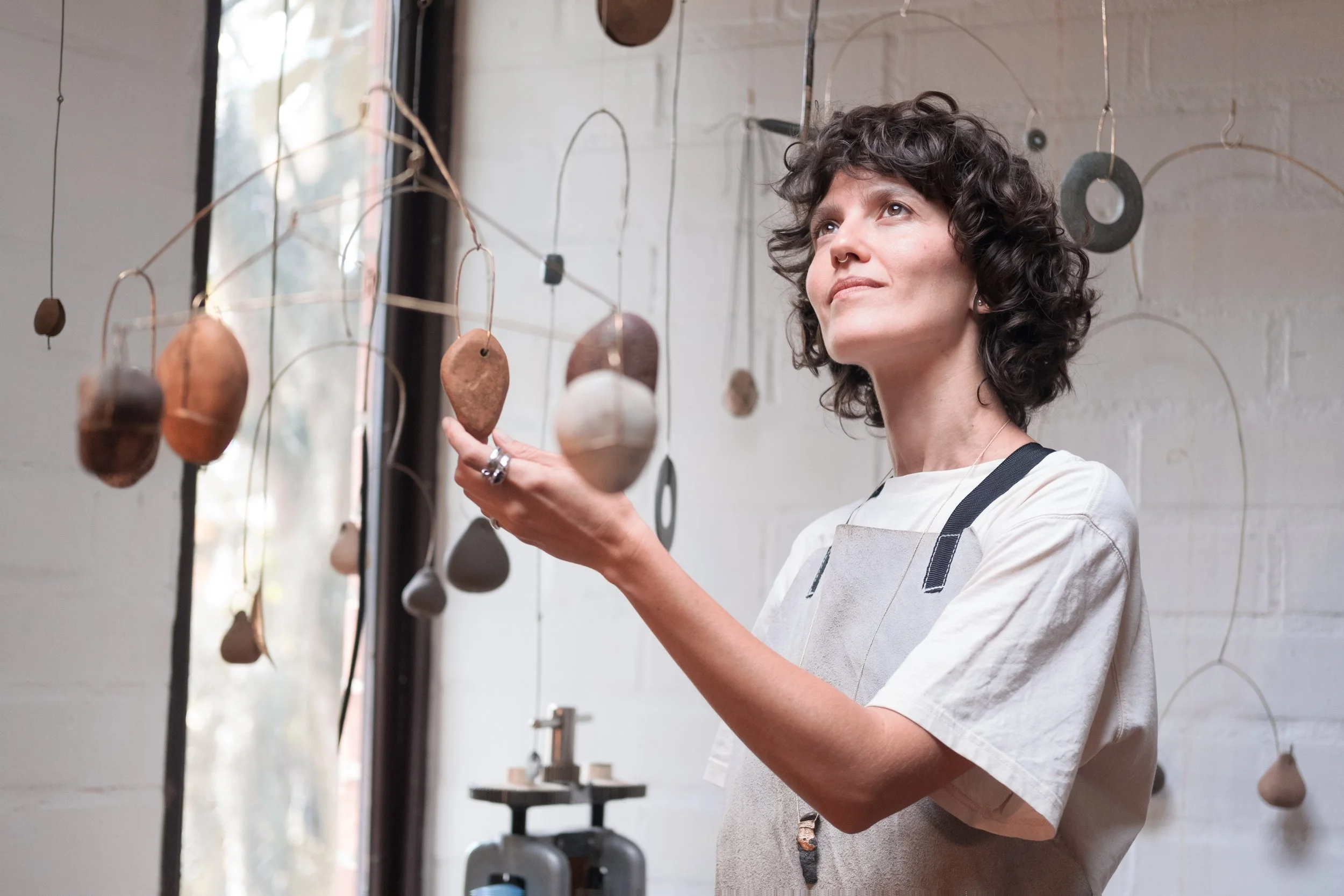
Work by Ana María Jiménez. Photo courtesy of Taller Sin Borde.
Marilena: I’ll ask about your research in a minute. Talk about the metals you work with.
Ana:
I work with silver, but I melt down old pieces and refine them. I work with gold only if it comes from old pieces—I don’t buy it. I also work with copper and brass, which I buy.
Using copper and brass is a way of saying that the value of my work isn’t about the cost of materials. Brass and copper are cheap. Gold is expensive because society tells us it is. My work is priced for the ideas and intention behind it. That’s why it’s expensive. I like working with materials that aren’t common in commercial jewelry making.
Today, a few communities still use artisanal methods to extract gold, such as panning. Many women do this work without mercury and with great care for the rivers and mountains. I would buy this gold, but it is often sold internationally because it’s so expensive. It’s very hard to find gold mined this way.
Marilena: That reminds me of the myth of El Dorado—a city of gold that European colonizers believed existed in what is now Colombia. What do you make of that myth?
Ana:
Something we need to understand is that most of what we read about Colombia was written by Spanish colonizers. Before they arrived, indigenous people didn’t write in the same way, so the texts we have come mostly from the colonizer’s point of view. In that view, gold equals money—an economic transaction.
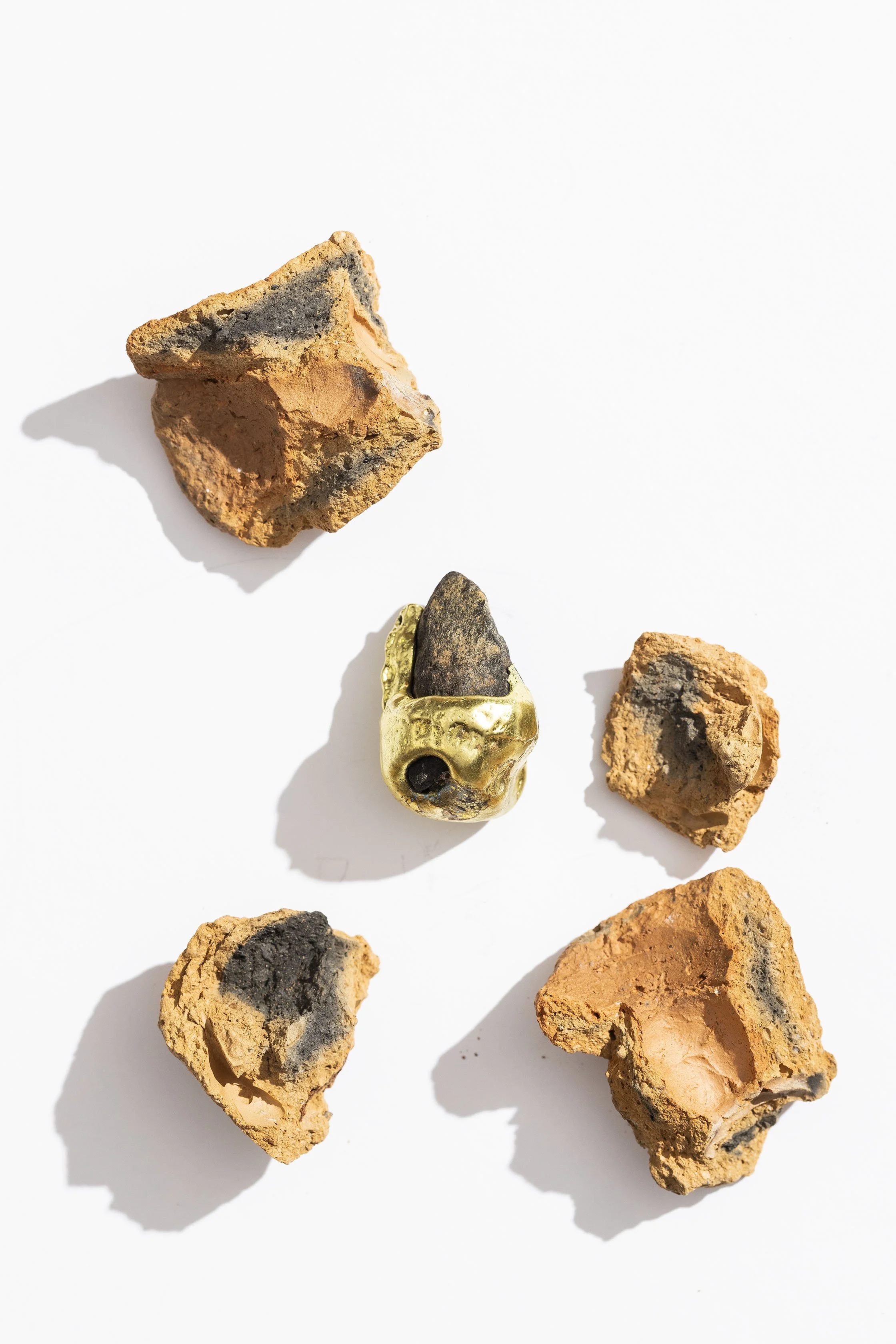
Work by Ana María Jiménez. Photo courtesy of Taller Sin Borde.
But otro punto is the indigenous perspective. For them, gold was the sun. It was a superior force. Copper was a force of the underworld. Tumbaga—an alloy of gold and copper made by ancient goldsmiths—is the meeting point between those two worlds. That’s absolutely beautiful. Knowing that changed everything for me.
Imagine having the power to create with those energies as a jeweler—bringing together sky and earth. If all you care about is grams of gold as money, you miss all of that.
Even just understanding that another worldview existed allows you to change your relationship with materials, with gold, with lakes and rivers. I never buy gold because I don’t want to be part of today’s supply chain or the gold-mining wars in Colombia. Gold has been tied to violence since colonization began over 500 years ago.
When customers ask me why I don’t buy gold, I explain that I don’t want to be associated with mercury pollution or with violence that destroys rivers and land. There is already enough gold in the world to recycle. I don’t care if it’s not exactly 18 karat. I’m lucky that my customers want to connect with these beliefs. It’s a decision about how you choose to relate to gold.
The story of colonization needs to change. Christopher Columbus didn’t “discover” this land. It was already a huge, wise, and beautiful world, deeply connected to materials, nature, energy, and symbolism. That world existed.
Marilena: Can you talk about your research and where it’s led?
Ana: At first, my question was technical: how were ancient Colombian jewelry pieces made? If I removed my hammer, rolling mill, and torch, how would I create what they created? I had no idea. I didn’t even know how to make sheet metal without a rolling mill.
I started talking to people in Colombia, hoping someone would teach me, but I quickly realized no one was practicing these techniques anymore. The knowledge wasn’t alive.
Then I had an unexpected conversation with a man who is called Mamo, a leader of an indigenous community in northern Colombia. I asked him why indigenous communities no longer work with metal jewelry. He told me that this knowledge had been negado, denied, because we no longer understand why metals were used.
That changed everything. The reasons indigenous people made jewelry were very different from the reasons we make jewelry today. I realized there was much more to understand beyond technique.
Through meditation and working slowly, I began to feel how ancient processes differed. When you work in a rush or focus on pricing, something changes. But when you work slowly, with intention and presence, thinking about the person you’re creating for, the process becomes something else. I try to keep returning to that, even though the world pushes us to rush.
Marilena: You’re describing the magic of jewelry as beginning at the site of production, not with the wearer. Almost as if jewelry-making itself is a form of ritual, not just how and when it is worn.
Ana:
Yes. When I first talked about this, people were confused. But I can feel the difference in my workshop. Not all pieces are made this way—it’s not possible—but some are very special. I still don’t fully understand what that energy is, but I know it exists. I think we’ve lost something in our perception. Something in our bodies is dormido, asleep. There are ways to wake it up—meditation, ritual, presence. For me, it’s meditation.
I once read that next to the Mamo, the community leaders, there were jewelers. Together, they made decisions. If the Mamo needed rain, the jewelers would create a piece with that intention. When I learned this, I wondered: why have we lost this power? Why can’t we ask permission again? I’ve tried melting metal without a torch, as the ancients did. That’s when I truly understood melting as a ritual. You must be connected to everything for it to work.
Marilena: Can you describe in detail how you melted?
Ana: I started by going to museums and reading books about how they did everything. So if I read, for example, they used a type of furnace for melting metal- say it’s this shape and it’s used in this way. Then I go to my workshop and try to reproduce the historical method I read about. Sometimes it worked; sometimes it didn’t. And in that process, I realized that there are a lot of things that historians and anthropologists keep writing and repeating, even though they’re not true. Their point of view is not that of a jeweler. So what I find very interesting is that I’m looking at this process from the jeweler's point of view and asking a lot of questions. For me, I’m trying to discover the truth.
As I'm redoing everything through this process, I’ve found many gaps and a lot we still don't know. For example, all the jewelry pieces from museums around the world were cast from melted metal. That's a fact. But we have only three small furnaces to account for thousands and thousands of jewelry artifacts. So what's going on here? In books and museums, the explanation is that jewelers harnessed wind power in the absence of gas-fueled blowtorches. To do this, it was said, they’d melt at the top of a mountain. So I recreated the furnace and went to the top of this mountain. There was a lot of wind. But I couldn't melt the metal. My teacher, Sergio Fernández, shared some techniques with me at the start of my research. Then I started to work with a friend who's a historian, Andrés Vélez. That was fantastic because he had all of this historical information, and I had the more practical information. We rebuilt one of the furnaces; it’s an exact replica of the original. We have done several melt trials using it. I conducted a trial in Texas with the Active Matter research group. We blew with our own breath for three hours, and we could melt tumbaga, the copper-and-gold alloy; we could reach our temperature goal of 1948°F.
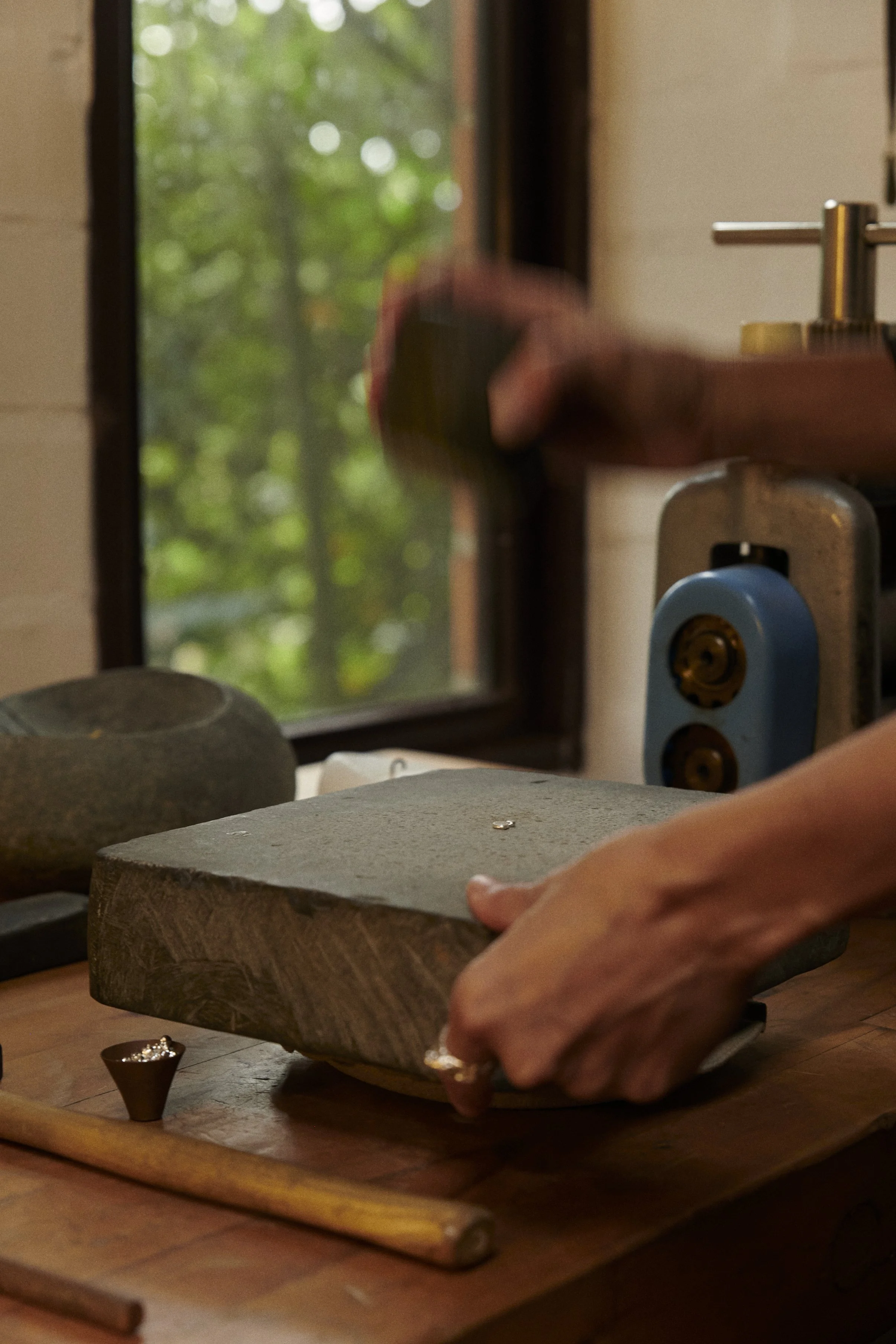
Work by Ana María Jiménez. Photo courtesy of Taller Sin Borde.
So now I can say how these lung-powered furnaces worked. That was one of my greatest days, and it was fantastic. In order for the process to work, you really need to be connected with the fire in a very different way. It’s not only about “knowing” how to do things. You need to really pay attention to the fire. You need to ask permission. You really need to have your intention very clear. Otherwise, the fire doesn't work. The fire doesn't burn hot enough. It's so...sorprendente- surprising. To melt this way, you need a big, big fire because you need to reach a high temperature and charcoal from a very good wood. And, you need people who can blow in a very potent way, with very strong and long breath.
During the melt, I was more perceiving the fire. Watching the fire. One friend was more into the fire, really blowing. Another person who, when he stopped blowing, caused the temperature to go down almost 300 degrees. So it is a collective activity, and we each play a different role. We took three hours. One person can’t do it alone. By the end, we were all in an altered state of consciousness. If you research breathing, you'll find it is still used today to heighten sensation, as if it were a kind of drug. We felt that way from how we were blowing and blowing and blowing. At the end, we had so much energy that the people who were around, who weren’t blowing, were like, “You need to stop, it’s too much! Aren’t you tired?” We were not even feeling our bodies. I felt sore the next day, with a lot of burning, but at the time, I didn’t feel any pain.
Work by Ana María Jiménez. Photo courtesy of Taller Sin Borde.
It was a ritual. It was magic. It was beautiful. It took three hours, but I think it could have been less, since at the beginning we were still trying to understand how to do it. So I think it could be 1.5 hours. We wrote an article about it, which includes amazing photos documenting the process and pre-Colombian artifacts made this way.
Marilena: That’s wild—especially since today you can melt metal in five minutes.
Ana:
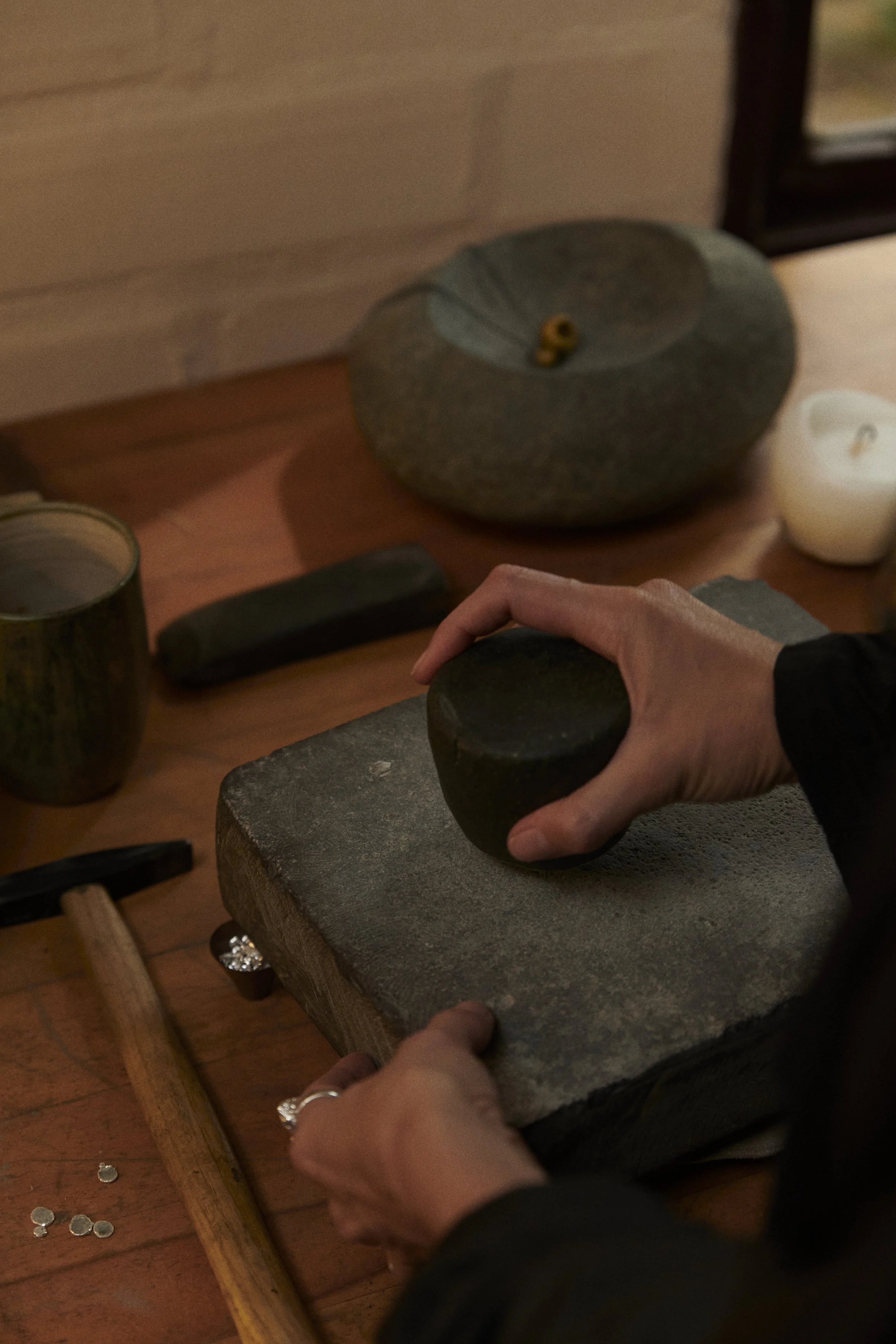
Exactly. Time and presence are everything for me. I’d rather hammer metal with stones for two hours than roll it in five minutes. With stones, your body becomes part of the process. It’s about time, intention, and relationship.
Most jewelry today begins with an ingot, a legacy of colonial systems in which gold equaled money. I prefer organic beginnings. I melt metal in water, stone, or wood, then hammer it into shape. It becomes a conversation between the metal and the stone.
I’m even developing a hammer with a wooden arm tied to a stone, because my back is struggling. But I love this way of working—it makes you feel your body differently.
Marilena: Thank you, Ana. Your work is incredible. Like you, I really value creativity and the relationship between creator and material. Together, they can be expressed in transcendent ways.
Follow Ana here:
Instagram: @tallersinborde
Website: www.tallersinborde.com
YouTube: Taller sin Borde
